
Any question about the article?
Please use your work e-mail, so we can connect with you
If you live in Australia or plan a destination fishing trip to Australia, no fishing trip would be complete without catching one of the country’s most iconic fish, the mighty Barramundi. In the northern areas of Australia, one of Australia’s most sought-after fish species is the Barramundi, and to make it even better, they taste great, too!
Translated from the Indigenous Australian language, Barramundi means ‘large-scaled river fish,’ and they definitely live up to that. Considering its size, power, habitat, and how it fights once hooked, it’s hard to find a fish in Australia that puts up a better, more challenging fight on rod and reel. If catching a Barramundi sounds like something you want to add to your fishing bucket list, you’ve come to the right place.
In the following guide to Barramundi fishing, we’ll cover:
If you’re in Australia and trying to plan your dream destination fishing trip around the country, be sure to check out the Top 12 Fishing Spots in Sydney: A Complete Guide, where we cover everything there is to know about the best fishing spots in and around Sydney.
Fishbox App is a premium Fishing Forecasting app that gives you access to advanced technology, including the best time to go fishing in Australia for Barramundi and when you’re better off relaxing at home and cleaning out your tackle box or boat ready for the next adventure.
The Barramundi, or Barra as the locals refer to it, has well and truly earned its nickname as the ‘silver ghost of the North’ for a reason, thanks to the skill and patience required to land one of these monster fish. Translated from indigenous Australian, Barramundi means ‘large-scaled river fish,’ and it’s an accurate description of these large fish. Barramundi’s scientific name is Lates Calcarifer.
Widely considered to be Australia’s most popular sports fish, thanks to the patience and skill required to hook and land one, Barramundi fishing is a once-in-a-lifetime experience that every angler should experience.
As we roll into 2025, anglers in Australia are looking at innovative new strategies for landing one of these prize fish.
Barramundi are an euryhaline fish species, which means that they can live in both freshwater and saltwater, along with brackish water, moving in and out of river areas and estuaries and surviving in creeks and rivers where many other fish species wouldn’t. However, they don’t like cold water, preferring to live in water with a temperature around 20-30 degrees Celsius.
While Australians like to claim the Barramundi as their own, they’re also found in several other countries, including South Asia, India, and the Philippines.
Barramundi is known by several other names, including Palmer Perch, Giant Seaperch, and Giant Perch, but for Australians, the Barramundi will always be the Barra. They are easily recognizable by their huge scales and concave forehead, which slopes dramatically back before arching up. Their color can change significantly depending on the environment they’re living in. Dark brown and green Barramundi typically spend a lot of time in freshwater, while the really bright silver ones spend more time close to saltwater.
With excellent vision, Barramundi spend their time close to the bottom, typically only hanging around close to the surface when it gets dark. Barramundi are typically protandrous, born as males, then transitioning into females as they get older. It’s typically females that are a lot bigger than their male counterparts.
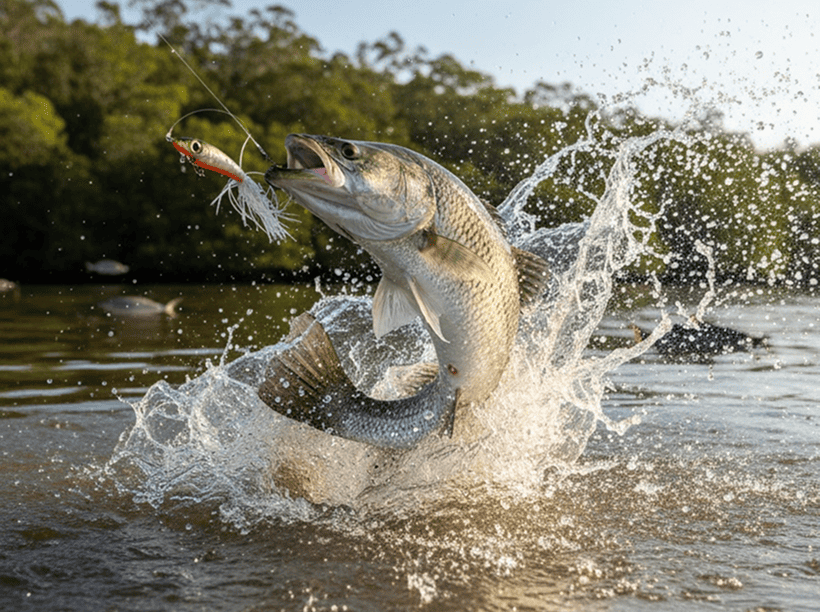
A decent-sized barramundi is typically around 100 cm long and weighs between 10 and 20 kg. What really sets Barramundi apart from many other fish species, especially freshwater species, is the aerobatic display they put on once hooked, leaping out of the water and shaking their head and body in an attempt to shake loose the hook in their mouth.
As if that isn’t enough to make Barramundi fishing sound too good to be true, Barra also tastes great, too, with white, flaky flesh that’s sweet and perfect regardless of how you cook it.
Almost every angler you ask would tell you that the Barramundi is an Australian fish, so you’d need to fish northern Australian destinations, but the Barramundi is available in various countries and locations worldwide.
Barramundi is widely distributed throughout the Indo-West Pacific area, all the way from the Persian Gulf through to China, Taiwan, Japan, Papua New Guinea, and, of course, northern Australia.
If you’re planning on fishing for Barramundi in Australia, you also have a lot of territory to choose from, as Barramundi can be found in Brisbane on the east coast and throughout Western Australia.
Interestingly, the Barramundi has a closely related cousin in Japan, known as the Akame, which translates to ‘red eye,’ and the fish look almost identical. There’s another fish in Africa known as the Nile Perch, which grows a lot larger than the Barramundi but looks a lot like it. However, the Nile Perch spends all its time in freshwater.
If you’re planning a fishing trip in Australia and you’re heading to known Barra water, there are a few things that you can look for. Barramundi are ambush hunters, lying in wait for their food to come to them, and they like to feel safe while they do it. So, you’ll want to look for underwater structures such as logs and trees where the Barramundi can wait and lurk.
Where to fish for Barramundi depends a lot on when you plan on going fishing. They spawn in estuaries but spend a lot of time in coastal areas, river and mud flats, lagoons, and tidal rivers. Any area where freshwater meets saltwater is a great place to start. Try casting around deep holes, creek mouths, snags, underwater logs, ledges, and mangroves. Brackish water, around 20 to 80 km from the coast, is the perfect place to start your hunt.
Despite their large size and ferocious fight, Barramundi can be quite lazy, preferring their meals to come to them rather than going out and actively hunting, so be patient when casting lures at snags. You might cast at one snag for an hour before your bait or lure lands in the sweet spot. It can take a little bit of trial and error to catch Barramundi, but they wouldn’t be known as the silver ghost of the North if they were easy to catch!
Some of the best and most iconic Australian Barramundi fishing locations include:
There are a variety of different ways that you can target Barramundi, and how you catch them will typically be determined by where you’re trying to catch them and the local environment. Below are the best techniques for catching Barramundi.
Casting or jigging are probably the most popular and effective methods of catching Barramundi. You can fish from the shore or from a boat, but a boat will allow you to fish back towards the shore and the structure around the shore, which can be quite effective.
The key to casting lures at Barramundi is changing up the retrieval speed. The lure needs to be moving slowly but still active and loud, attracting attention. Remember, you almost need your lure or jig to swim past the Barramundi’s nose, as they’re quite lazy and won’t move far to strike.
Getting them to hit your lure or jig is the first challenge, but hooking and landing them are the next. Because Barramundi have a hard mouth, even though they take the lure, getting it to set can be quite tricky, and when you add in flying leaps and headshakes, you’re in for a real challenge.
Once you hook up, keep that line tight. If you give them any slack, they seize on that opportunity to shake the lure loose. If you are lucky enough to land a Barramundi, extra care should be taken when handling the fish, especially if you plan on releasing it. Use a net to lift them into the boat and handle them with two hands, supporting them carefully.
Trolling is another effective method of catching big Barramundi. It allows you to cover a lot of territory on the water and can be a nice way to relax between casting sessions. How you troll will depend on the depth of the water.
Shallow trolling at around 10 kph is excellent in water that’s less than 1mt deep. If you’re trolling deep water, you’ll need to rely on a depth sounder to find that underwater structure, adjusting your depth and speed accordingly.
The last method we’re going to talk about is night fishing. While productive, night fishing for Barramundi comes with its own risks. You and the Barramundi aren’t the only ones out and about, with crocodiles also using the cover of darkness to hunt for food. If you’re planning on fishing for a night for Barramundi, avoid areas with crocodiles.
A lot of local anglers swear by the full moon’s light, but any lights close to water where Barramundi can hide in the dark waiting for baitfish will prove productive. Again, check the area you plan on fishing in, which is free of crocodiles, and bring along the bug spray; you’ll need it!
Barramundi are around and biting all year, but there are peak seasons when they’re going to be more active, and the best season is the wet season. Anytime from November through to around the end of May is great. If you’d like to narrow that down even more, the best time during the wet season is between March and May. This is when Barramundi are spawning, so they’re hungry, aggressive, and most comfortable due to warm water temperatures.
When you’re considering what time of day to go out chasing Barra, you need to think about light conditions. Low-light times, sunrise and sunset are perfect, along with night fishing. The darker it is, the braver the Barramundi get, moving a lot closer to the surface of the water in search of food to ambush. However, as we mentioned previously, if you plan on fishing at night or anytime close to dark, make sure the area is free of crocodiles.
In Australia, most states have a closed season to give Barramundi a break from angling pressure. It typically runs from around October to February, but check with the local regulations in the state you plan on fishing in.
You won’t need anything spectacular to catch Barramundi, but your fishing tackle will need to be up to scratch if you want to successfully land one of these wily monsters.
Rod – A fishing rod of around 2 meters will be perfect. The longer the rod, the harder it will be to get those accurate casts in. Precision is the name of the game, and the closer you can get your lure to that snag, the better your chances of hooking up will be. A 2.5 to 7.5kg rod weight will serve you well.
Reel – You have a couple of choices when it comes to the type of reel. Bait casters are great if you’re experienced with them, but they are hard for beginners. At the same time, the classic egg-beater reel will serve you well. Light reels are for spinning and jigging, stronger reels are for trolling, where the Barramundi strike and hit your lure harder.
Line – With the fishing line, you have the choice of mono or braid. Mono is between 10 and 15 kg if you are bait fishing and 7 to 10 kg braid if you are lure fishing. Either way, a 20 to 30-kg mono leader is essential and will prevent your lure from getting cut off on snags.
Below, we’ll go through some excellent Barramundi fishing tips for beginners who are just getting started for the first time in the exciting world of big Barra fishing!
With the information above, your chances of catching one of Australia’s most iconic fish, the mighty Barramundi, will be much higher. If you’re getting into Barramundi fishing, take the time to read the information in the article above, and you’ll be in a much better position.
Before you cast a line in pursuit of a Barramundi, please check with local state regulations about licensing requirements, size, season, and bag limits. If we all do our part to be responsible anglers, we can ensure that future generations of anglers in Australia get to catch these beautiful fish for many more years to come.
The premium fish forecasting application, Fishbox App, will put you in the perfect position to catch some great fish by analyzing local weather and water conditions and input from local anglers. The Fishbox App utilizes accurate weather, tide, and fishing conditions to predict the best time to get out on the water to catch your target species.
Do you have any fishing advice or tips for anglers targeting Barramundi? Drop a comment below! We love hearing your thoughts and feedback, and we’re sure new anglers will appreciate any help they can get before their first Barramundi fishing trip.
Once again, as I mentioned earlier, I’ve never had the luxury of going to Australia—let alone catching a barramundi. However, after reading this article, I’m even more convinced that I need to go and catch one of these beasts. I can’t compare the barramundi to anything I’ve ever caught. A tarpon or snook is the closest thing I can think of when looking at the pictures, but I don’t even have experience catching those.
Anyways, without further delay, let’s jump straight into breaking down this article. After a quick introduction, the author tells us about the barramundi and its different characteristics. He mentions how acrobatic the fish is, which makes me think it’s more similar to a tarpon than I initially realized. The author also tells us that these fish can be once-in-a-lifetime catches and live in fresh and saltwater. However, the big difference between a barramundi and a tarpon is that a barramundi is great on the table.
That being said, the author shows that the barramundi is the ultimate sportfish. It puts up a fight, grows considerably, is hard to catch, and tastes great—all the makings of an awesome fish.
The article continues into a discussion of where to catch these beautiful fish, listing various locations that are super helpful to the reader. One of the main takeaways from this section is that barramundi are ambush predators. Knowing this helps me adjust my strategies accordingly. Additionally, the author clarifies that these fish love to cover—whether it’s deep holes, ledges, drop-offs, weeds, or more. This gives new barramundi anglers a great place to start when looking for these amazing fish.
The article’s next section details the best tactics to catch them, including night fishing, trolling, jigging, and more—all of which I’ve had experience with for different species in my home waters.
The article then talks about the best times of year to fish for barramundi, noting that the wet season is your best bet. This was cool to hear because, in America, we don’t have a “wet season”—we just have spring, summer, fall, and winter.
The gear section comes next, and this was one of my favorite parts of the entire article because it details what new anglers should be buying to take on this species. The setup seems simple, and you can go in many ways, depending on your fishing preferences. If you want to troll for barramundi, get a decent trolling combo. If you would like to use a baitcaster, that can work, too. I love how there are so many different ways to approach this fishery.
The last thing we get before the conclusion is bullet points with helpful tips. The ones that stood out to me were the importance of keeping your line tight, finding structure, and handling these fish carefully. These tips go beyond just barramundi and should be applied whenever you’re out fishing.
I hope you enjoyed reading this article and my commentary!