

Skipjack Tuna
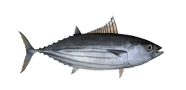
The skipjack tuna is a fast-swimming, pelagic fish with a streamlined body and dark horizontal stripes on its lower sides. Found in warm oceans worldwide, it is a highly migratory species, often forming large schools. Skipjack tuna is prized both commercially and by sport anglers for its strong fight and abundant presence. It is a key species in global tuna fisheries, often caught using various methods such as purse seining and trolling.
 Length~80 (max 108)
 Weight~9 (max 34)
 WaterSalt
 Water Temp15-30° F
 Depth259 ft
- Other namesKatsuo, Arctic bonito, Mushmouth, Oceanic bonito, Striped tuna
- Length~80 (max 108)
- Weight~9 (max 34)
- WaterSalt
- Water Temp15-30° F
- Depth259 ft
Popular lures for Skipjack Tuna

Regulation for Skipjack Tuna
- Season-
- Bag limit-
- Vessel limit-
- Trophy limits-
- Max size-
- Min size-
- Measurement-
- Prohibited methods-
Living Conditions
🐟 Habitat preferences
- Skipjack tuna inhabit open ocean waters, typically found in tropical and subtropical regions where the water is warm
- They are a pelagic species, spending most of their time in the upper layers of the water column, often near the surface
- This species is highly migratory, traveling long distances following ocean currents and food sources like small fish, crustaceans, and squid
- Skipjack tuna are commonly found in large schools, sometimes associated with other tuna species or marine animals like dolphins
♻️ Life cycle and mating behavior
- Spawning occurs year-round in tropical waters, with peak periods depending on the region. Skipjack tuna spawn in open waters, releasing eggs that are buoyant and develop in the pelagic zone
- The larvae are planktonic, growing quickly in warm, nutrient-rich waters before becoming juveniles that join adult schools
- As they mature, skipjack tuna continue to migrate extensively, moving between feeding and breeding grounds in response to environmental cues such as water temperature and prey availability
- Their strong migratory behavior is closely linked to ocean currents, which help distribute larvae and sustain populations across vast oceanic areas